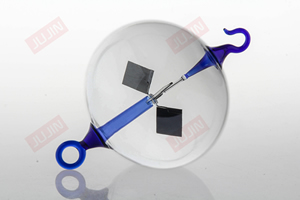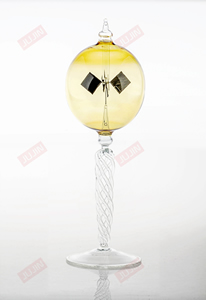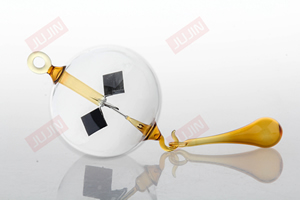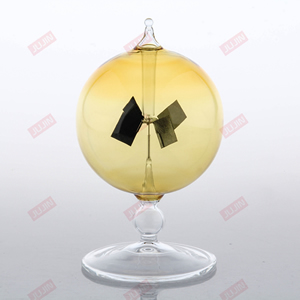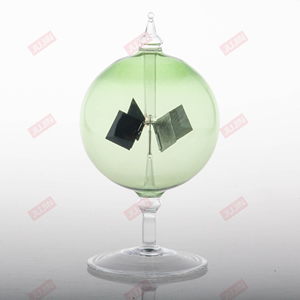


Office Home Decoration Blades Rotating Glass Windmill Solar Powered Crookes Radiometer Light Mill Educational Teaching Study Tool Physics Toy Driven by Light Energy Sun Energy
Originally, designed by William Crooke in the 1860's, the radiometer still fascinates both young and old.
The Crookes radiometer, also known as a light mill, consists of an airtight glass bulb, containing a partial vacuum. Inside are a set of vanes which are mounted on a spindle. The vanes rotate when exposed to light, with faster rotation for more intense light, providing a quantitative measurement of electromagnetic radiation intensity. The reason for the rotation was a cause of much scientific debate in the ten years following the invention of the device, but in 1879 the currently accepted explanation for the rotation was published. Today the device is mainly used in physics education as a demonstration of a heat engine run by light energy.
It was invented in 1873 by the chemist Sir William Crookes as the by-product of some chemical research. In the course of very accurate quantitative chemical work, he was weighing samples in a partially evacuated chamber to reduce the effect of air currents, and noticed the weighings were disturbed when sunlight shone on the balance. Investigating this effect, he created the device named after him.
It is still manufactured and sold as an educational aid or curiosity.
Construction: A glass bulb contains a low-friction spindle with four lightweight vanes.
Vanes: Each vane is coated with a black surface on one side and a white or polished surface on the other.
Partial Vacuum: Most of the air is removed from the glass bulb to create a partial vacuum.
Light Exposure: When exposed to light, the black sides of the vanes absorb more heat and become warmer than the white sides.
Molecular Momentum: The gas molecules on the warmer black side are faster and collide with the edges of the vane, imparting a greater "kick" compared to the cooler, slower molecules on the white side.
Rotation: This difference in force causes the vanes to rotate, with the black sides retreating from the radiation source.
Key features:
Energy Conversion: It acts as a simple heat engine, converting light into rotational motion.
Light Source: It responds to sunlight, artificial light, and even infrared radiation, with rotation speed increasing with light intensity.
Educational Tool: The radiometer is a fascinating physical and technical demonstration used to illustrate principles of physics.